
ATELIER V.V. - TECHNIQUES - BLOCKPRINT
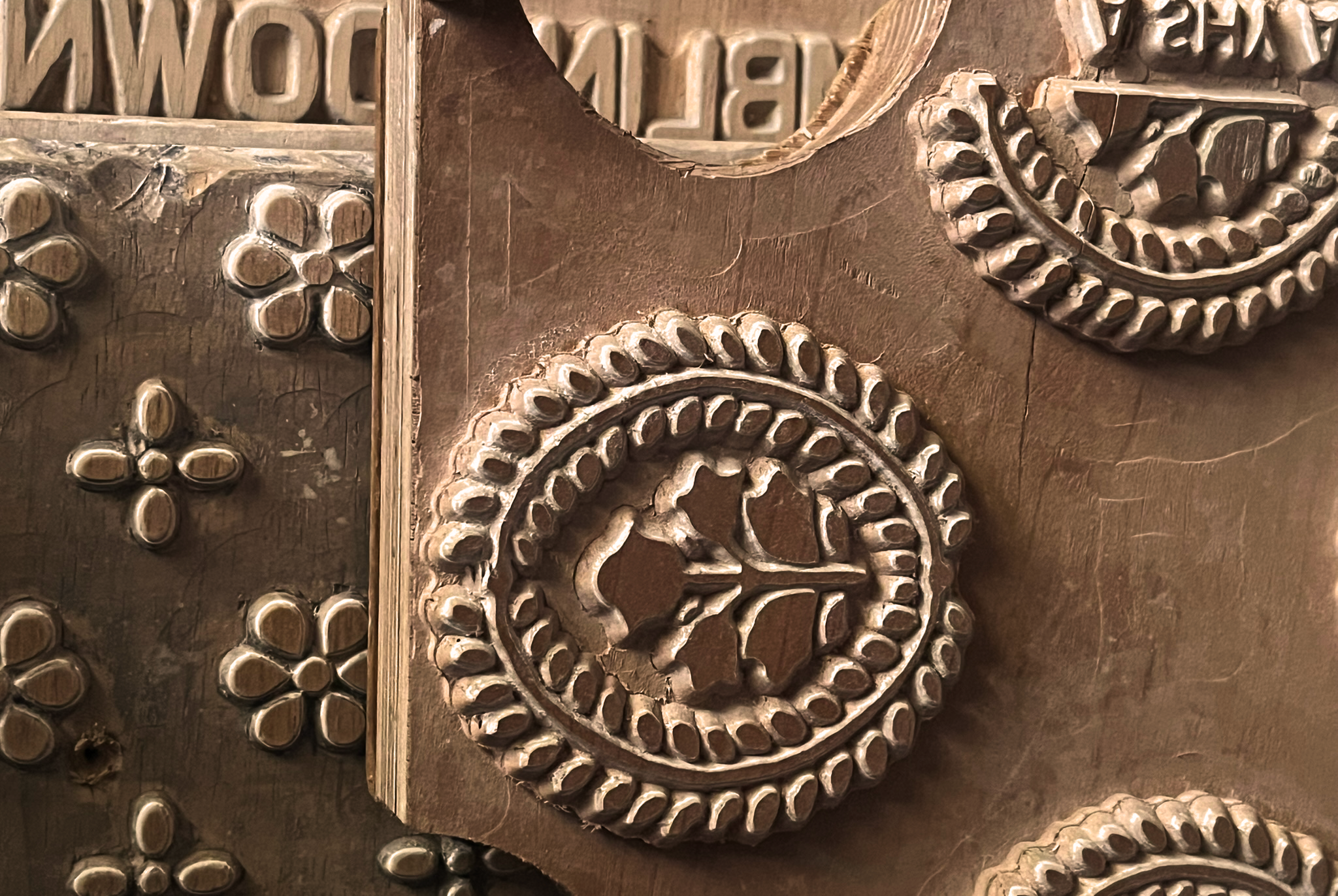
Pearwood blocks pressed into distemper paint made from chalk, animal glue, and non-toxic pigments. Colour by colour, layer by layer. A technique with centuries of history, and one of the few places in the world still practising it.
Block
print
MADE IN
Sint-Maria-Latem
PAINT
Distemper
BLOCKS
Pearwood
THE TECHNIQUE
18th c.
EUROPEAN TRADITION
20th c.
HIGH-END PRODUCTION ONLY
Today
ONE OF THE FEW LEFT
A European craft that survived only at the very top of the market.
Blockprinting wallpaper is not specifically Belgian. It is a European technique, practised from the 18th century across France, England, Germany, and beyond, wherever there was a wallpaper industry and the appetite for something that machines couldn't replicate.
By the 20th century, industrial printing had taken over almost completely. Blockprint survived only at the highest end of the market, studios producing small runs of exceptional quality for clients who understood the difference. Belgium's wallpaper history is rich, but it was built on industrial production. Usine Peeters Lacroix, once one of the major Belgian wallpaper manufacturers, maintained a small blockprint workshop alongside its industrial presses as long as it operated. That combination, industrial scale and artisan craft side by side, was unusual, and it is now gone.
What remains of the blockprint tradition exists in a handful of workshops across Europe. We are one of them, the only one in Belgium printing blockprint wallpaper by hand today.
01
The block
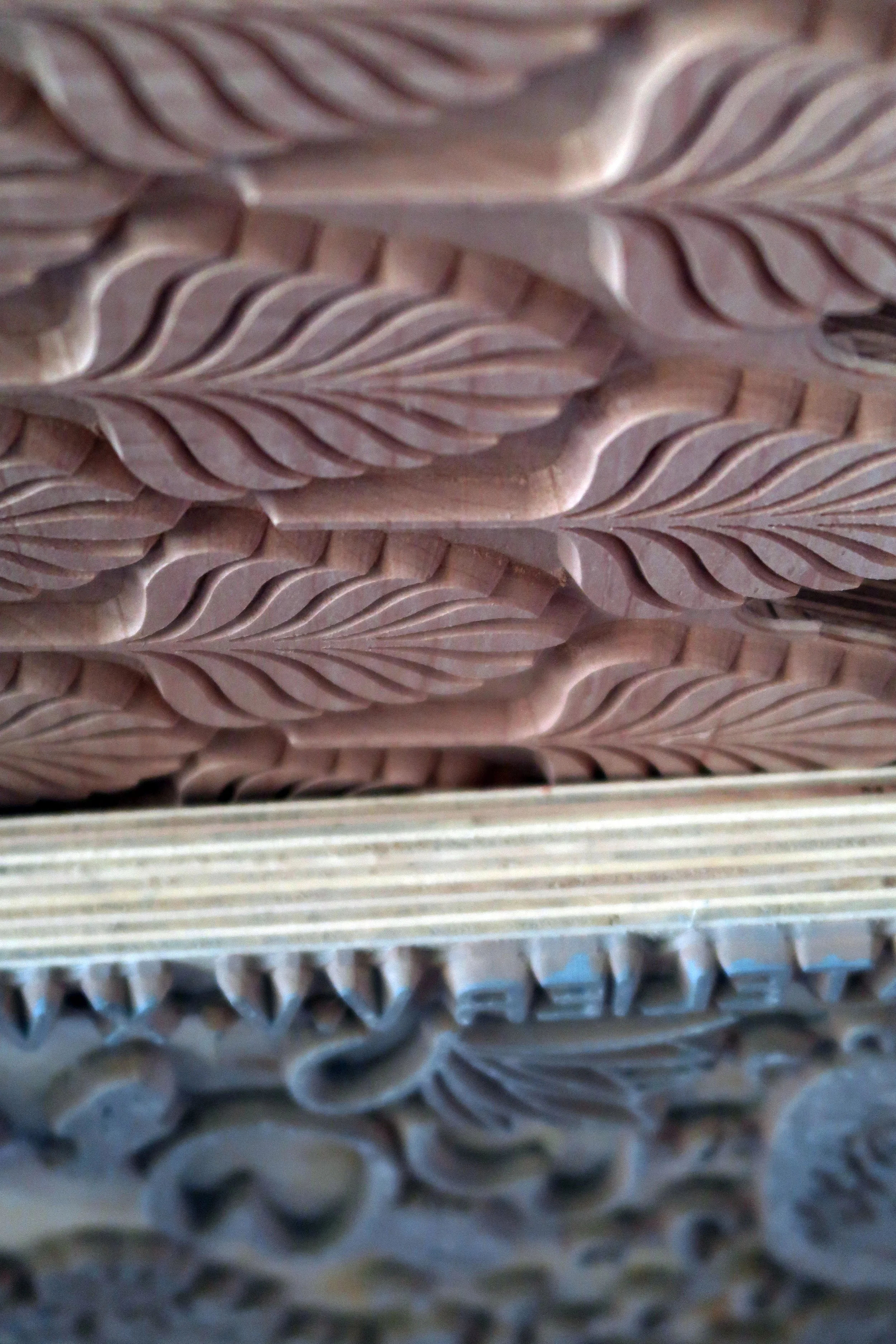
Each colour in a pattern requires its own pearwood block, cut by CNC to precise tolerances and finished by hand. A three-colour pattern means three blocks. Each must register exactly with the others. One to two days of cutting per block depending on complexity.
02
The paint preparation
Distemper is made the day before printing. Chalk soaks overnight, hide glue dissolves slowly, pigments are mixed in warm. Twenty-four hours minimum. It cannot be rushed.
03
The inking table
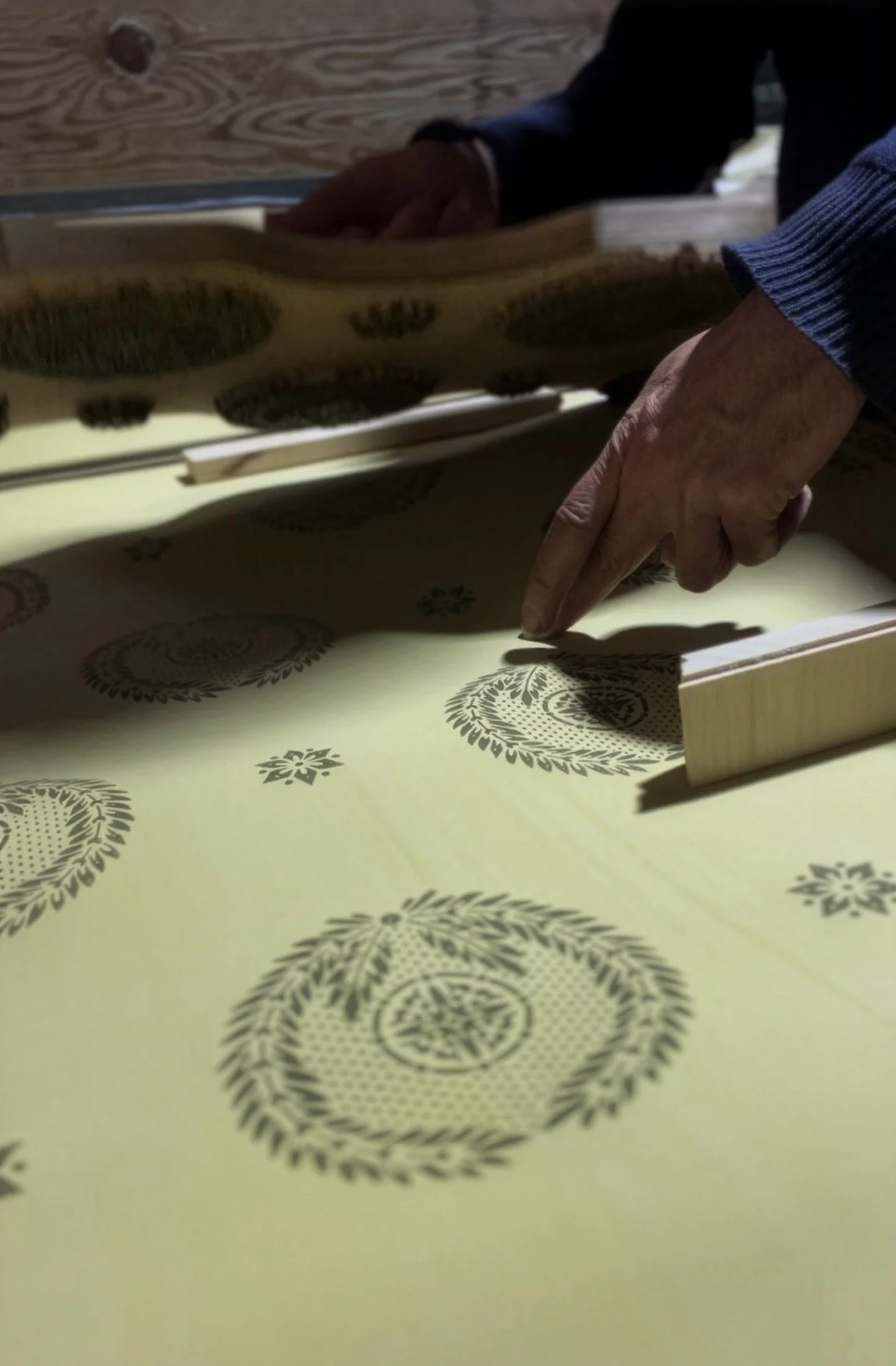
A piece of cloth or felt is laid on a sheet of leather with water underneath. The water allows the leather to give slightly this is what ensures the paint is taken up evenly by the block each time. Before every print, paint is applied to the cloth or felt. The block is pressed onto it, then onto the paper. This is the rhythm of blockprinting: ink, press, lift, repeat.
04
The printing press
Our printing press had to be rebuilt from scratch. Luckily we made some decent pictures of the hand-press in the wallpaper museum. Together with a friend we painstakingly copied the original 18th century original.
05
Printing
The block goes to the paper. One colour at a time, one length at a time. Each colour must dry before the next begins. The layers build slowly. Two people work in rhythm throughout.
06
The result
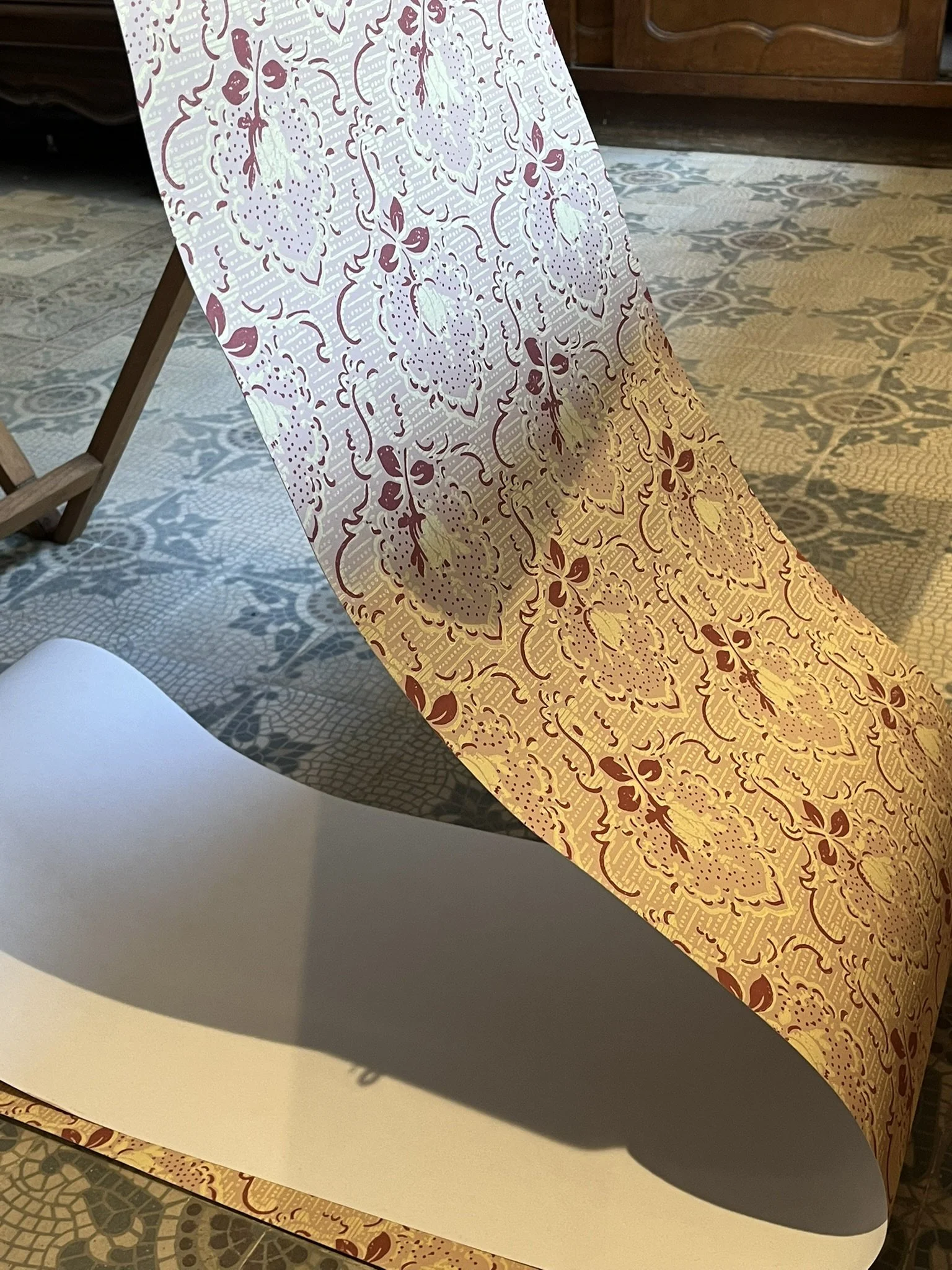
A matte, velvety surface unlike anything a machine produces. Slight variation between prints. The impression of the block visible in the paint. That is not imperfection, it is the signature of the process.
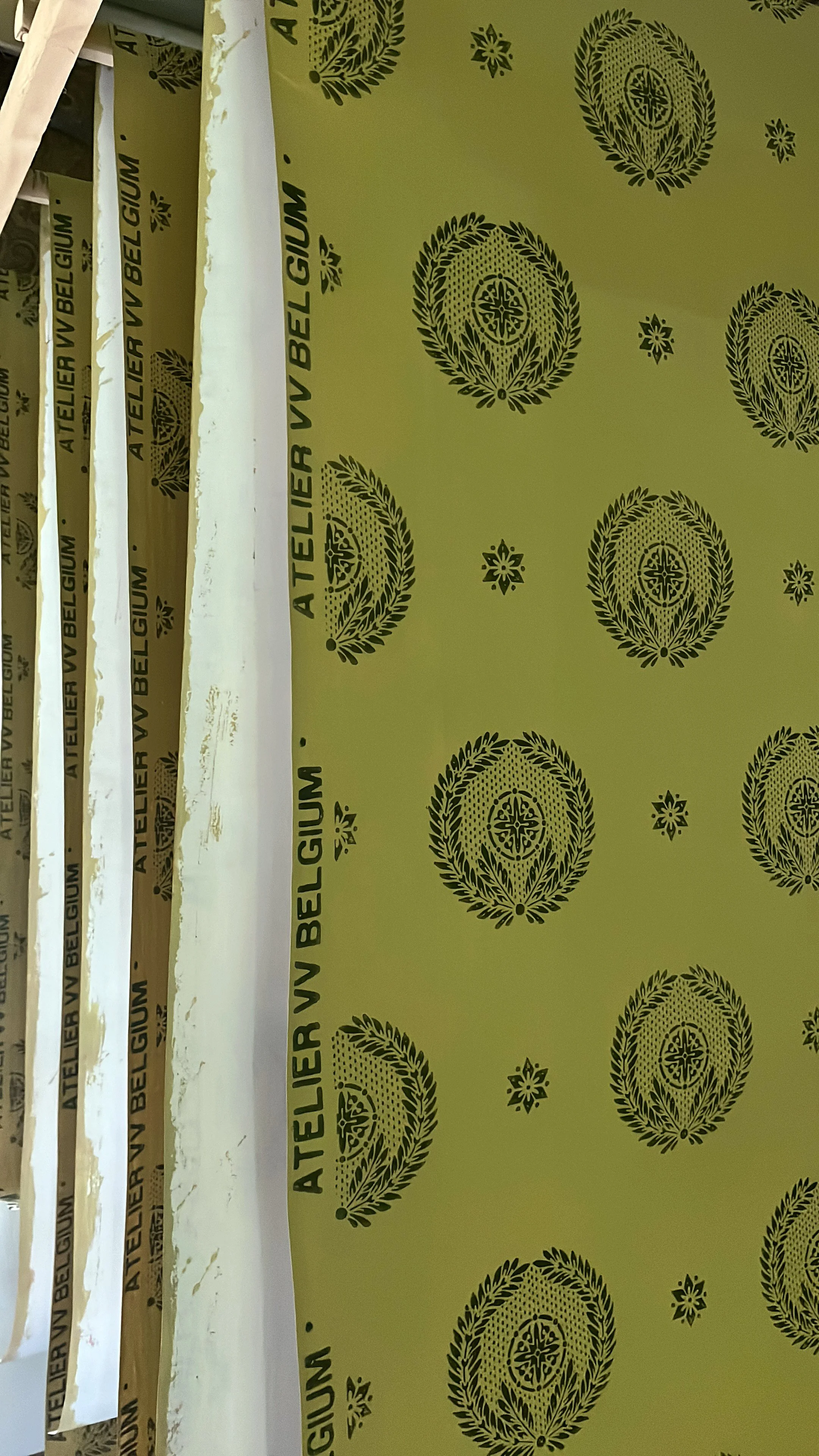
Painting the background
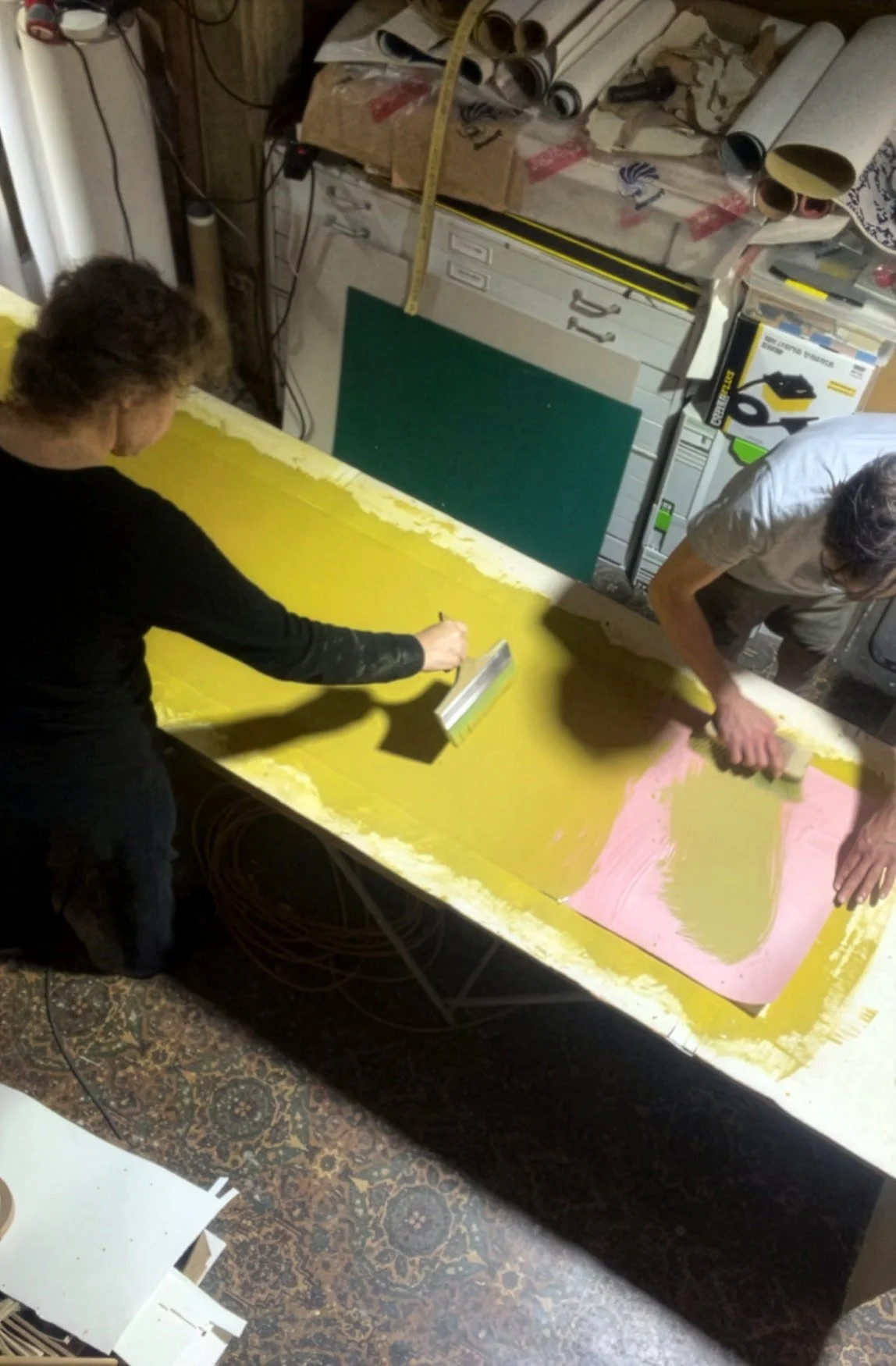
Before any block touches paper, the background colour goes down first. The paper is laid flat on a large table. The distemper paint is kept warm au bain marie alongside , distemper waits for no one.
This is a two-person job and the two people have different roles. Dimitri works quickly across the sheet with a large brush, loading the paint on fast and evenly. Vicky follows immediately with a very fine, very soft brush, laying the paint into a single strokeless layer before it has any chance to dry unevenly or show the direction of the brush. The window between the two passes is short.
The painted sheets are then hung to dry. When they are ready, the background is the first colour, and the block printing begins on top of it, colour by colour, from there.
This painted ground is one of the things that makes blockprint different from our other two techniques. In linocut and dominoté, the paper itself is the background, the natural white of the paper or the warm brown of the kraft. In blockprint, the background is almost always painted first. That additional layer is part of what gives blockprint its particular depth. You are looking through the pattern into a surface that has already been worked.
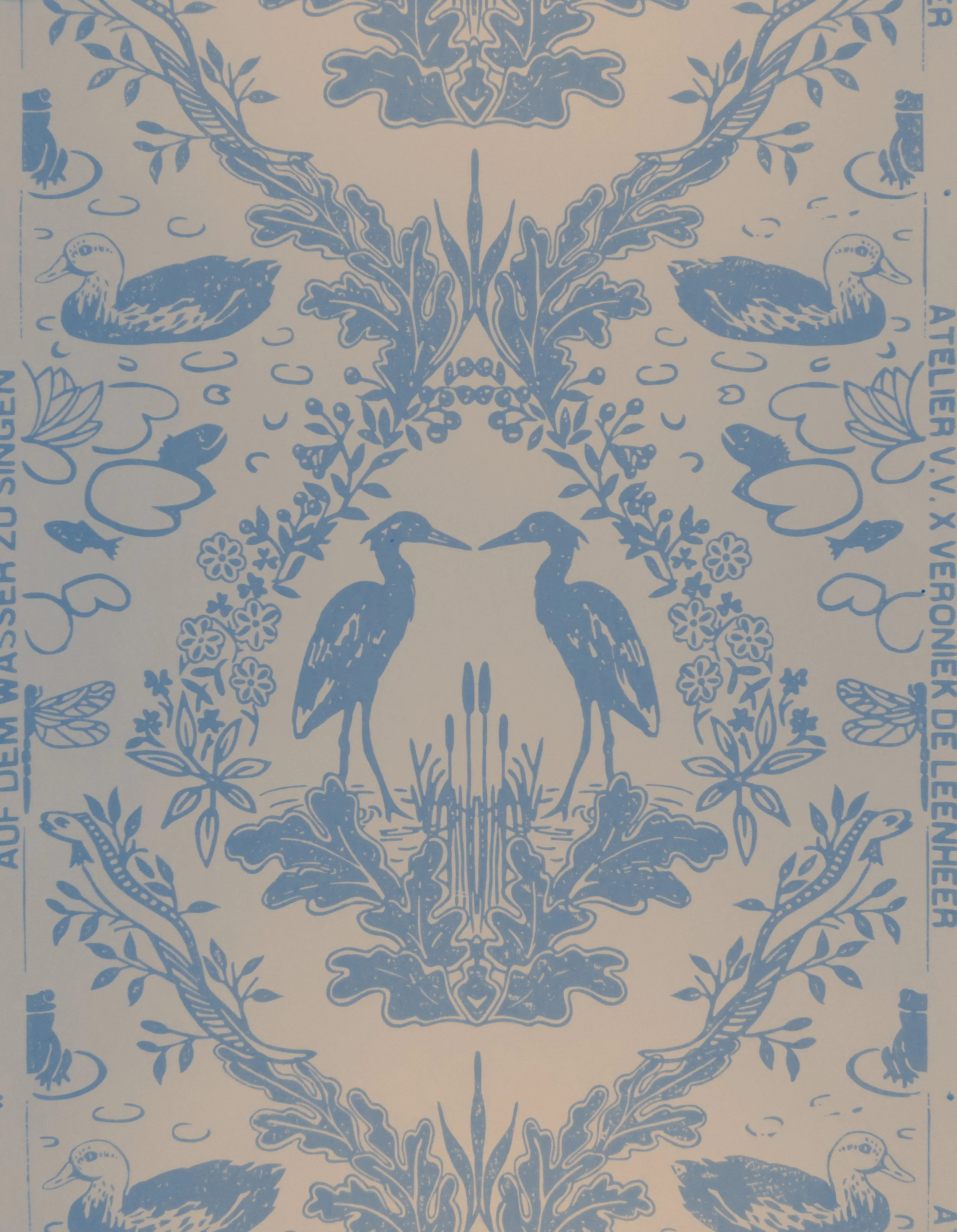
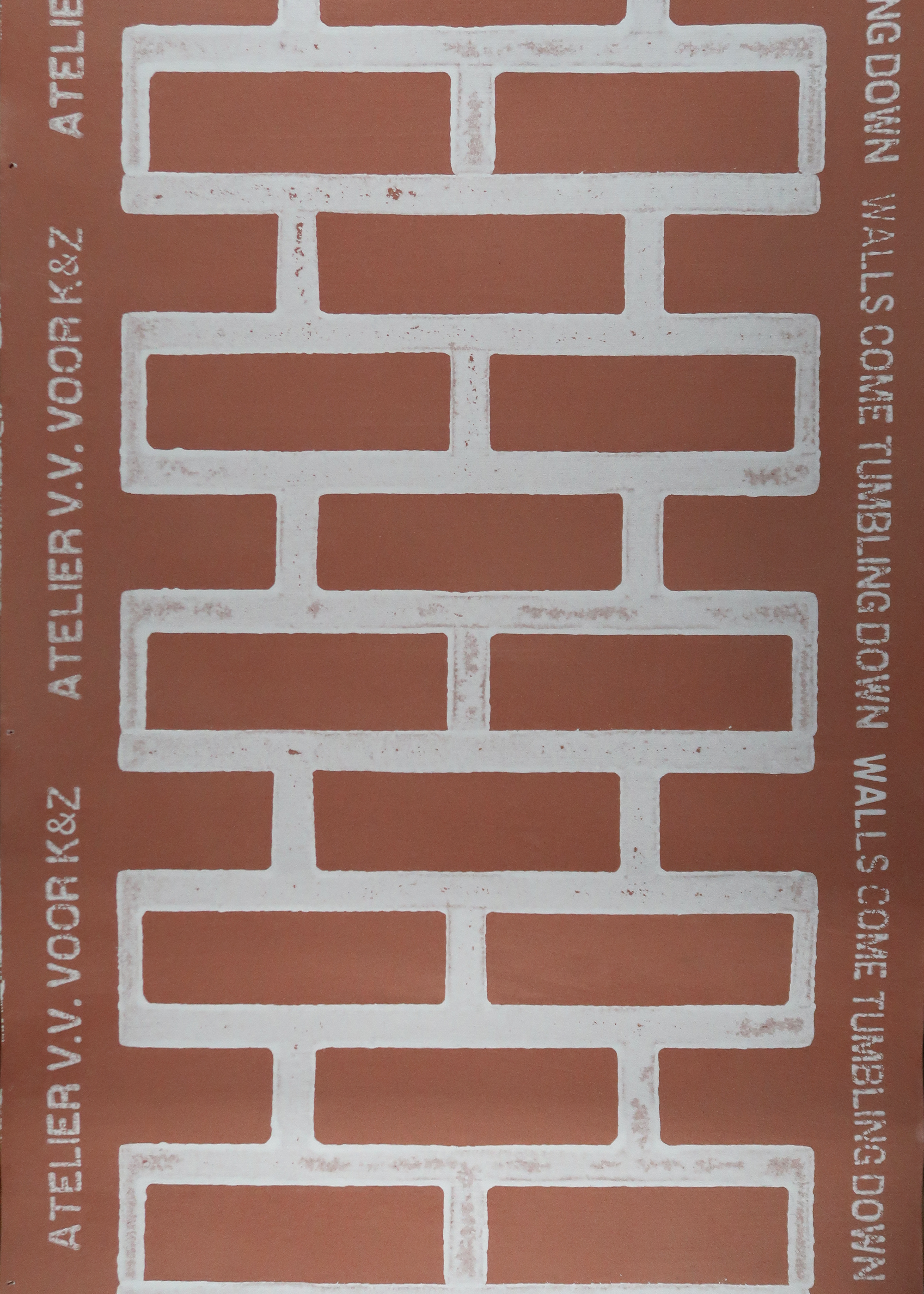
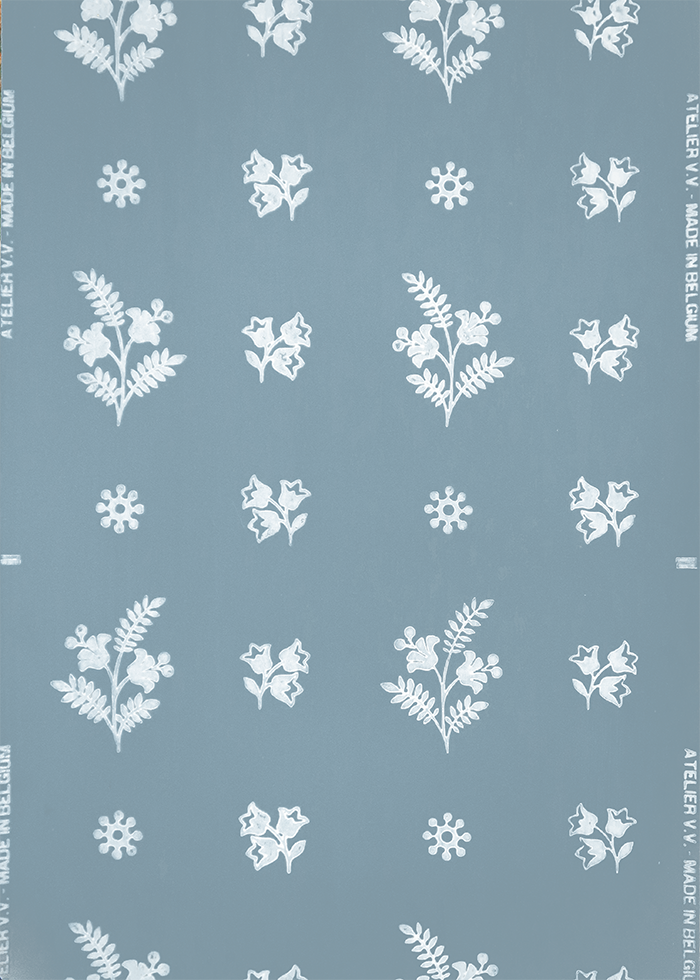
We print original contemporary designs and historically accurate reproductions. Both are made exactly the same way — by hand, in distemper, with pearwood blocks. The difference is in the starting point, not the process.
Two kinds of pattern.
CONTEMPORARY
New patterns
Original designs developed in the atelier or in collaboration with artists and designers. Contemporary in sensibility, handprinted by a technique that predates the industrial revolution. The patterns are ours, or made together with someone whose visual world has a natural conversation with blockprint.
Available in any colour from our pigment palette, on any of the three papers we offer. Made to order, to the exact dimensions of your project.
SEE THE CATALOGUE
HISTORICAL
Pattern book
We hold a pattern book of historical designs — reproductions drawn from archive sources, museum collections, and fragments from heritage projects. Patterns that were once printed in ateliers like ours, rebuilt here from research and careful observation.
For heritage architects and conservation projects, we can also reconstruct a specific historic pattern from whatever survives, a fragment, a photograph, an archive reference. See the heritage page for how that works.
HERITAGE RESTAURATION

The paint.
Our distemper is not bought from a tin. It is made here, the day before it is used, from ingredients that have not really changed since the 18th century.
MADE FROM SCRATCH - EVERY TIME
Chalk gives the paint its matte, velvety body. Hide glue binds it without forming a film — the dried paint remains breathable and flexible. No acrylic, no synthetic binder. Nothing that seals the wall off from the building.
The colour comes from pigment, earth minerals and carefully chosen modern non-toxic alternatives where historical pigments were harmful. Mixed into the warm paint by eye, adjusted until right. We keep a colour book of exact proportions so every batch matches the last.
The paint is processed warm, and applied to the inking cloth fresh. Vicky prepares it. It cannot wait.
Distemper paint
Chalk
Hide glue
Water
Pigment
Temperature
Preparation
Soaked overnight
Dissolved slowly
As needed
Non-toxic · Mixed to order
Applied warm
1 day
No acrylics. No synthetic binders. Breathable and flexible.
The palette
We work with historical earth pigments where they are the right choice, and with modern non-toxic alternatives where historical pigments were harmful. The principle is always non-toxic, not that it must be old. Any colour can be mixed from our palette.
Ultramarine
Burnt umber
Indigo blue
Raw umber
Ochre de Provence
Oxide black
Brenticino green
Vine black
Venetian red
…
Oxide red
Every colour is mixed by hand, to the specific tone the project requires. No digital matching. Vicky mixes by eye — and keeps a colour book of exact proportions so every batch can be reproduced. If you need a specific colour, bring us a reference.
Three papers.
Different character,
same craft.
The paper changes the way the distemper sits, how the surface reads across a room, and what the wall ultimately feels like. We offer three — each with a distinct character and a different application.
PRACTICAL
Non-woven
A modern base paper made from cellulose fibres, sourced from industrial waste streams. Dimensionally stable, easy to hang, and durable. The practical choice for contemporary interiors where longevity and ease of installation matter as much as character. Takes distemper cleanly and holds it well.
RAW
Kraft
Unbleached cellulose, warm, earthy, raw. The natural brown tone of the paper becomes part of the design. Used mainly without a background. Unexpected in an interior. Unforgettable once seen.
HISTORICAL
Thin cotton rag
A fine art paper made from cotton fibres, the same material used by printmakers for centuries. Lightweight, with a subtle texture that accepts distemper with exceptional richness. The finest surface we offer for blockprint. For interiors where the quality of the paper is part of the statement.
Because every roll is printed to order, nothing is fixed. The colour of the paint is mixed from scratch for your project, matched to a fabric, a stone, a piece of furniture, whatever the room requires.
We work directly with interior architects and private clients on each project. Bring us the space, the brief, or just a reference, and we'll tell you honestly what's possible and what it will take.
Any colour. Any pattern.
Made for your project.
Custom colour
Any paint colour mixed by hand from our pigment palette to match your brief
Made to measure
Printed to the exact dimensions of your walls, no wasted paper
Pattern from the book
Historical patterns available from our archive, adapted if needed
Heritage reconstruction
Specific historic pattern rebuilt from fragment or archive, see the heritage page
Practical information
Hand blockprint
Any colour — 12+ pigments mixed to order
Distemper — chalk, hide glue, pigment
Price from €60 / m²
CNC cut pearwood blocks
Printed to order
Non-woven · Kraft · Thin cotton rag
€5 per sample ·
Colour changes everything.
A pattern on screen tells you nothing about how distemper reads in a real room. Request a sample and hold it in your hands.